

Black Amber: What It Is and Why It's So Special
When most people hear the word “amber,” they picture a warm, honey-coloured stone washed ashore by the Baltic Sea after a storm. But nature loves to surprise. There exists an amber that is entirely black – mysterious, deep, like a fragment of the night sky. For centuries, it has raised more questions than any other variety: what exactly is it? Is it really amber? And what is its true name?
In this guide, we answer the most common questions about dark amber and black amber – from its origins and properties to its fascinating history and place in modern jewellery.
What is black amber actually called?
The answer is not as straightforward as you might think. “Black amber” is a trade name that covers several distinct materials. Depending on what you are holding, it could be one of three things:
Jet – the most common material sold as “black amber.” Jet is not amber at all. It is fossilised wood from ancient trees, compressed over millions of years into a dense, polishable form of coal. It is completely opaque, lightweight, and warm to the touch – which is why it is so easily confused with amber. The name “jet” derives from the ancient Greek word “gagates,” after the town of Gagae in modern-day Turkey.
Stantienite – this is the true black Baltic amber. An extremely rare amber variety, named after the East Prussian entrepreneur Stantien. Stantienite is fossilised tree resin, just like regular amber, but black in colour due to specific chemical processes during its formation. It is characterised by its fragility and a deep, matte black surface that develops a subtle sheen when polished.
Earthy amber – this is ordinary Baltic amber that absorbed a large amount of soil, bark, or other organic matter during its formation. These inclusions give the amber a dark or black appearance, even though its base is the same fossilised conifer resin. In some cases, the resin content in such amber can be as low as 15%.
What is the difference between jet and true black amber?
Although they look similar – both black, lightweight, and warm to the touch – jet and genuine black Baltic amber are entirely different materials.
Amber formed from conifer tree resin. Jet formed from the wood itself. Amber took approximately 40–50 million years to harden into fossilised resin. Jet followed a similar timeline, but its starting material was wood tissue that carbonised under immense pressure over millions of years.
The simplest way to tell them apart is strong light. Hold a piece of true black Baltic amber against a bright light, and its edges will often glow with a deep red or brown hue. Jet remains completely opaque under any light. Another difference is scent. When burned or vigorously rubbed, amber releases a pleasant pine resin aroma, while jet produces a distinctly coal-like smell.
The history of dark amber: from talismans to Queen Victoria
Black amber and jet share a thousand-year history intertwined with magic, protection, and mourning.
The ancient Romans transported jet from the coasts of Britain and believed it could ward off the “evil eye” and absorb negative energy. Egyptian nobility adorned themselves with dark amber pieces, while the Baltic tribes considered black amber a protective talisman against enemies.
However, jet reached its greatest popularity in 19th-century Britain. When Queen Victoria lost her beloved husband Prince Albert, she entered a prolonged period of mourning. Court etiquette demanded only black jewellery – and jet was the perfect material. It was light enough to create large, impressive necklaces and earrings that, despite their striking size, were comfortable to wear. During the Victorian era, jet became a symbol not only of grief but of elegant restraint.
In Lithuania, black amber held a special place as well. It was considered the most powerful of all amber shades – the most energetically active, the most protective against negative forces. Although black amber is the most fragile and difficult to work with, that is precisely why it was so valued – a piece crafted from black amber required exceptional skill.
Properties of black amber
Black amber – whether true stantienite or jet – has been associated with extraordinary energetic qualities since ancient times.
It is traditionally believed that black amber absorbs negative energy and helps restore inner balance. This is why it is often called the “stone of grief” – not because it brings sadness, but because it helps you process and release it. In ancient cultures, it was worn during mourning as a symbol of protection and peace.
In crystal healing traditions, black amber is linked to the root chakra. It is believed to help ground the wearer, ease anxiety, and restore emotional equilibrium.
From a physical perspective, both jet and black amber are remarkably lightweight (lighter than most stones of a similar size), warm to the touch, and gentle on the skin. Their hardness on the Mohs scale is only 2–3, meaning they require particularly gentle care – protection from impacts, chemicals, and direct sunlight.
Dark amber jewellery today
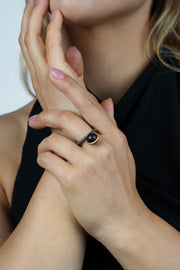
In modern jewellery, black amber is experiencing a renaissance. It is no longer just a “mourning stone” – today it is one of the most stylish and versatile choices, equally suited to everyday wear and evening occasions.
Black amber bracelets, necklaces, and earrings pair effortlessly with any outfit – from a classic black dress to casual weekend style. Black is a timeless colour that never goes out of fashion.
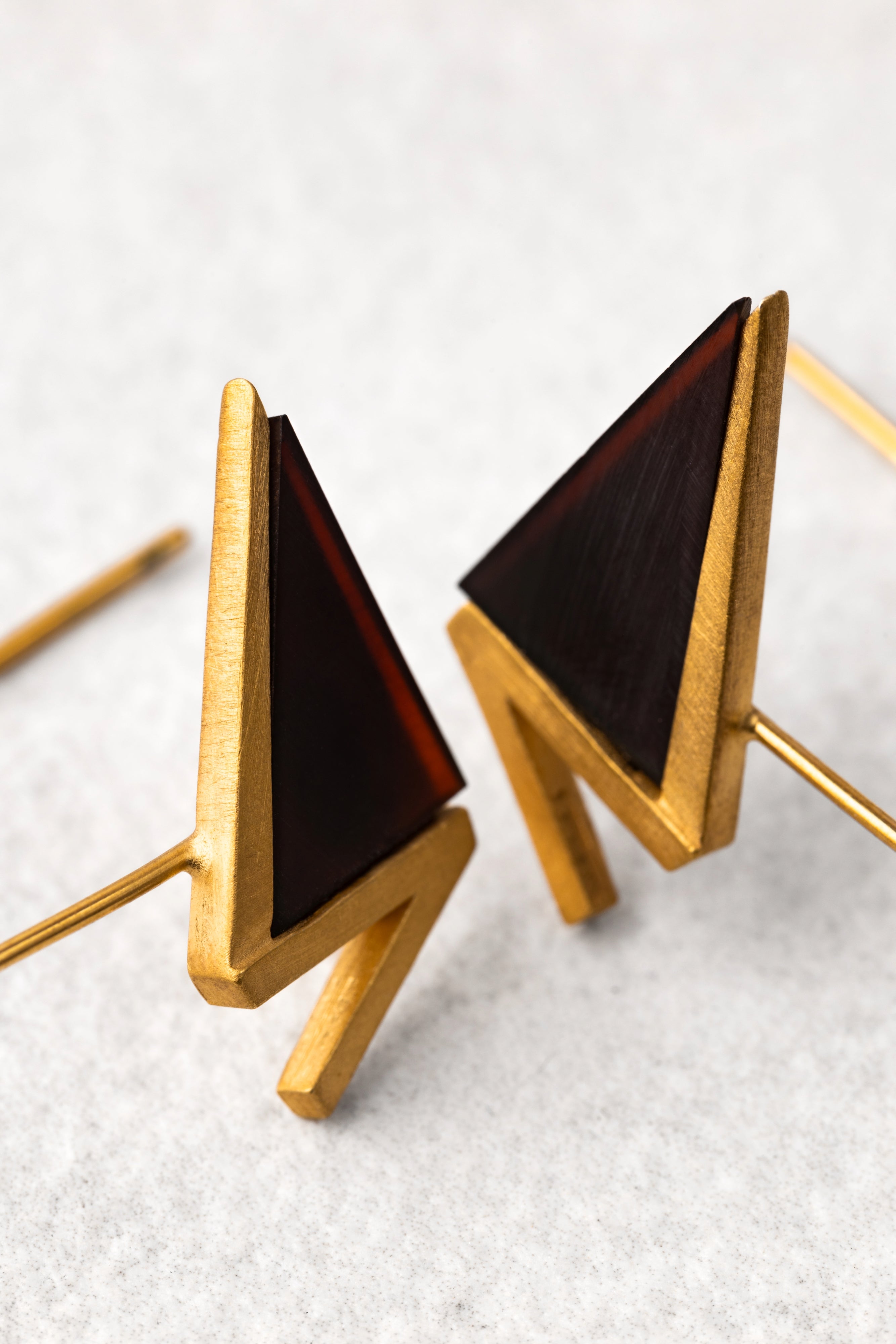
In the BANGUOJA collections, amber is used in its natural state – never pressed, heated, or artificially altered in colour or structure. Every piece of dark amber is exactly as nature created it – with its own unique texture, inclusions, and character. Set in 925 sterling silver or 24K gold-plated silver, black amber takes on a contemporary, premium jewellery expression.
How to care for black amber jewellery
Black amber is the most fragile of all amber varieties, so it requires especially gentle care:
- Clean with a soft, slightly damp cloth – never use chemical cleaners or alcohol.
- Store separately from other jewellery in a soft box to prevent scratching.
- Avoid contact with perfume, hairspray, and household chemicals – apply them before putting on your jewellery, not after.
- Protect from direct sunlight and high temperatures.
- Remove before swimming, exercising, or doing physical work.
With proper care, a black amber piece can last for decades – and, much like the amber itself over those millions of years, only gain more character with time.
Black amber – the darkness that holds the light
Black amber was never meant for the masses. It has always been for those who seek something beyond sparkle – for those who value history, symbolism, and authenticity.
Whether it is jet, stantienite, or earthy Baltic amber – each of these materials carries its own unique origin story, its own character, and its own meaning. This is jewellery that does not shout, but whispers. That does not display, but tells a story.
If you are looking for an amber piece that is not just beautiful but meaningful – black amber may be exactly what you have been searching for.
Discover the BANGUOJA handcrafted Baltic amber jewellery collections – every piece is made by hand from natural Baltic amber, 925 sterling silver, and 24K gold-plated silver.